Tuesday, July 20, 2010

Gunung Mulu National Park, Malaysian Borneo


So for those of you who are avid Planet Earth fans, this one might make you really jealous: We have just returned from Mulu National Park, the home of the enormous Deer Cave, which was featured in the Planet Earth "Caves" episode, and is just as cool as one would imagine from watching the show.  It was the largest cave passage known to man until recently (a larger one was found in Vietnam in 2009), and is big enough to fly a jumbo jet through (1.2 miles long, and never less than 270 feet high and wide). In other words, this thing is MASSIVE. Planet Earth fame aside, the entirety of Mulu National Park is awesome. We stayed at a "homestay" just outside of the park entrance, and spent 3 days and 2 nights exploring the park.

(Note: Anyone thinking of going to Mulu will be interested to know that the accommodation provided by the park (i.e. headquarters and the Royal Mulu Resort) is NOT the only place to stay, despite what they tell you. There are plenty of homestays (hostels) outside the park, but because of some stupid political issue they aren't allowed to advertise the fact that they exist. We were among those who almost decided not to go to Mulu because the park HQ rooms were booked up, but through word of mouth we found out about these homestays, and everything turned out fine. Mulu Park politics: 0, Preston and Jessica: 1.)

The suspension bridge leading to the park HQ.


Yep, we're in the jungle.


The entrance to Deer Cave. This is a really hard thing to take a picture of, considering how huge it is, but rest assured that it looks much more impressive than this photo of ours.


Inside Deer Cave. We actually didn't take this picture (because our camera is terrible), but this really is what it looks like. As a reference, if there was a person standing in this picture you wouldn't even be able to see them they'd be so small.


Abe Lincoln! 
We swear this is not a product of photoshop, it is a natural stone formation inside Deer Cave. Crazy, huh?


As Planet Earth-ers will also recall, Mulu is also the place where each night literally MILLIONS of bats make a mass exodus from Deer Cave to go hunting. Besides being a sight to see, we ended up adoring these bats for the simple fact that they eat 15 tons of insects every night, mosquitos included; we were in a rainforest for 3 days and got maybe 4 mosquito bites between us! Hallelujiah!


3 MILLION (yes, million) bats exit Deer Cave every night to hunt. The stream seems to go on forever... When we get back, ask to see a video we took, it's awesome.


Sunset on the river on our walk back from seeing the bats.


The hills of Mulu Park at sunset.


The street just outside our hostel.


Before we got to Mulu, Preston did some research on the park and decided that we had to do some "adventure caving" while we were there. Upon arrival, we found out three things: 1) in order to do any adventure caving you have to do the intermediate Racer Cave first to prove that you can handle it, 2) there are only 8 spots per day for Racer Cave and it had been booked for months, and 3) if you beg the staff profusely and tell them how far you came to get to Mulu, they will squeeze you into the group anyway. Mulu Park politics: 0, Preston and Jessica: 2. And it was all worth it! We went to a remote cave with a small group of people, squeezeed, climbed, and crawled our way into the heart of the cave with only our Adidas Kampung (rubber Malaysian trekking shoes) and our headlamps to guide us.

 Jessica's ready to do some spelunking.


Heading down the river to Racer Cave.


Cool tree on the bank of the river.


Just inside the entrance of Racer Cave.


The namesake of this cave, a Racer Snake.


Jessica rappelling (well, at least the less-safe Borneo version of rappelling) down the cave wall.


What our guide called "Adam and Eve's Shower".


Huntsman spider.... holy cow. This thing was easily 6 inches in diameter. According to our guide they are "maybe poisonous, it depends on your antibodies"... uh, what?


Preston scaling another wall.

Besides Deer Cave and Racer Cave, we also visited Lang's Cave (small, but beautiful), Clearwater Cave (one of the longest caves in the world), and Wind Cave. We loved all of them, but we could see why Deer Cave gets the most press. We also hiked out to Paku Waterfall (great place to swim), and did a Canopy Walk through the forest.

The river on a misty morning. We were on our way to Clearwater and Wind Caves.


Cool tree(s?) on our hike to Paku Waterfall.


Preston swimming beneath the falls. (The falls themselves weren't as impressive as we had hoped, but it was still a great place to swim.)


Weirdest caterpillar we've ever seen.


On the canopy skywalk.


The little prop plane that took us to and from Mulu from Miri. (You can also get to the park by boat, but for whatever reason, this mode of transport is about $75 more expensive than just flying.)


View from the plane. Goodbye Mulu!


And now it's on to Niah Caves National Park, and then to our last city in Borneo, Kuching... We don't want to leave!

Friday, July 9, 2010

Bandar Seri Begawan, Brunei Darussalam

On our way down the coast of Borneo, we did a quick stint (literally less than 24 hours) in Brunei. I don't think we stand alone in saying that the mention of Brunei brings up images of a tiny country with lots of oil and a very very rich Sultan. After having been there, we can safely say that these images are in no way a stereotype but completely true. For a reference on the size of this country, Washington State is 32 times bigger than the whole of Brunei, and where Brunei boasts a population of 388,000 people total, Seattle alone has a population of 2.7 million. In other words, Brunei is not much more than a blip on a map. The other typical image associated with Brunei is it's famous (or infamous, depending who's side you're on) Sultan of Brunei. It is true what you hear; he is listed as the "Richest Royal in the World", weighing in at a whopping $22 billion. The last image, oil, is less obvious to the naked eye, but since we personally passed 3 oil fields on our way from point A to B, we're sure this one is true as well. Overall, though, Brunei--or at least Bandar Seri Begawan--has a bit of a weird vibe. Unlike every other asian city we've been to, there seemed to be a lack of "stuff" going on. No honking cars, very few motorbikes, only a few people walking around, and sidewalks you can actually walk down. Weird. It feels a bit like a country club: Very clean, very organized, and very un-used looking. This may not seem so weird to those at home, but to us, having been on sensory overload for the past 3 1/2 months, it was a little unnerving to be in a city like this.

Like we said, our time in Brunei was very short, but I think we managed to hit the highlights. We got in around 4pm, and by 6:30 the sky gave us an incredible show, beautifully showcasing the National Mosque, which even on it's own is a sight to see. The next day we headed out on a river tour, which found us in the oldest floating village in the world, and closer than we've ever been to some Proboscis Monkeys!! (We got a semi-decent picture this time, which is an accomplishment for our stupid camera.)

The easiest way to reach Brunei from KK was via this ferry.


The Sultan's picture was everywhere. This billboard in particular was advertising his upcoming 64th birthday on July 15th; actually, every building in the city had a sign advertising the same thing. Should be quite a party!


The National Mosque.


The National Mosque in the day...


...and the Mosque at night!


The sunset put on quite a show.


Military helicopters practicing for the Sultan's birthday celebration.


Jessica and the Mosque on our boat tour.


The floating (stilted) village. At first we weren't all that interested in this part of the tour (we've seen plenty of floating villages already), but we later found out why this one is particular is so cool: until the turn of the century when the British arrived, this village was 100,000 people strong, and was all there was to the city of Bandar Seri Begawan. The British tried to move it's inhabitants to dry land, but to this day it is a thriving community of 30,000 with every amenity. There are huge schools, a hospital, a police station, a fire station, and sturdy sidewalks.


The beautiful Brunei River.


Our guides for the day (they were brothers).


Jessica trying to get a good look at the Proboscis Monkeys.


A Bornean Egret.


So if you look in the middle of the picture, just above the bushes, you'll see a humanoid figure leaning against a tree... This is a Proboscis Monkey! Our camera still wasn't that capable, but this is better than before, for sure! From where we were standing, these monkeys were about 30 yards away.


On our way out of Brunei we had some trouble. We were told that a bus to Miri (the city in Malaysia we were heading to) left from the border town of Kuala Belait at 3:30, but it was, in fact, discontinued as of July 1st, so we nearly ended up stuck in a border town. After asking literally everyone we could find what our best option was, we had to fork out 50 USD for a 40 minute cab ride... Ouch.

So, all in all, Brunei was interesting, but I don't think either of us would recommend it as a "place you have to go in your life". It was fine to pass through, but with the expense and the lack of goings-on, it was a bit missable. Our next stop, though, Mulu National Park in Malaysia is supposed to be amazing!

Kota Kinabalu and around, Malaysian Borneo

We left the natural jungle of the Kinabatangan and headed for the concrete jungle of Kota Kinabalu, the largest city in Malaysian Borneo. KK (the "international nickname" for Kota Kinabalu) is the capital city of Sabah situated on the northwest corner of the state. The city lies in the shadow of Mount Kinabalu; the largest mountain in SE Asia, about the same size as Rainier! The trip from Sandakan to KK took us up and over the Kinabalu mountain pass, and though the mountain is perpetually cloaked in fog, the clouds lifted just long enough for us to take some beautiful pictures from the bus!  

The peak of Kinabalu, standing 13,435 ft.


Clouds hang in the valley below the mountain

KK is the largest city in Borneo, but it's still relatively small (population 600,000) and we quickly gained the lay of the land. The city was originally owned by the British North Borneo Company and was establish to ship natural materials out of Borneo. The port is still the lifeline of the city, though tourism is steadily picking up; it has the largest airport in Malaysian Borneo, and is the gateway for the majority of travelers entering the island.

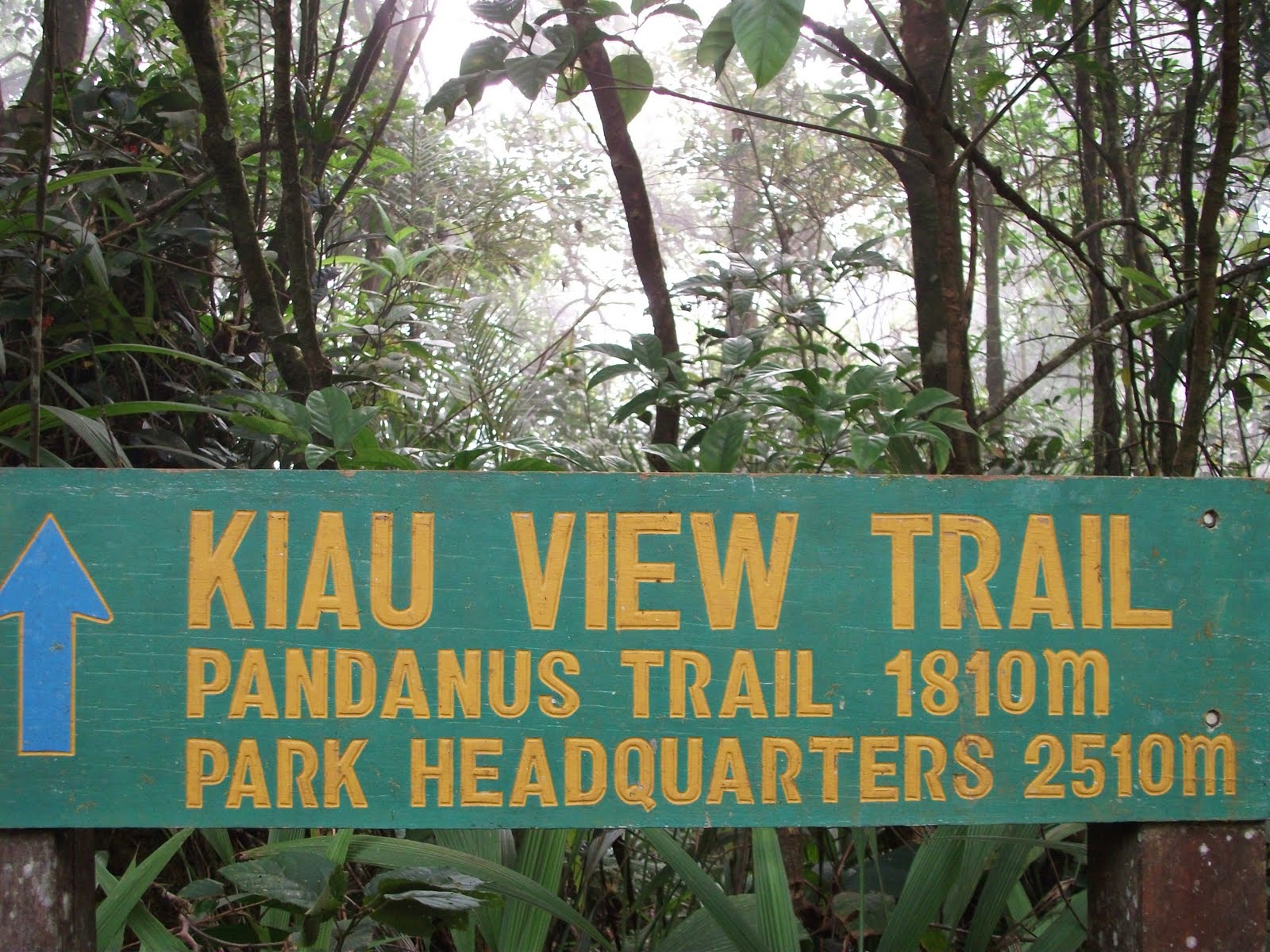
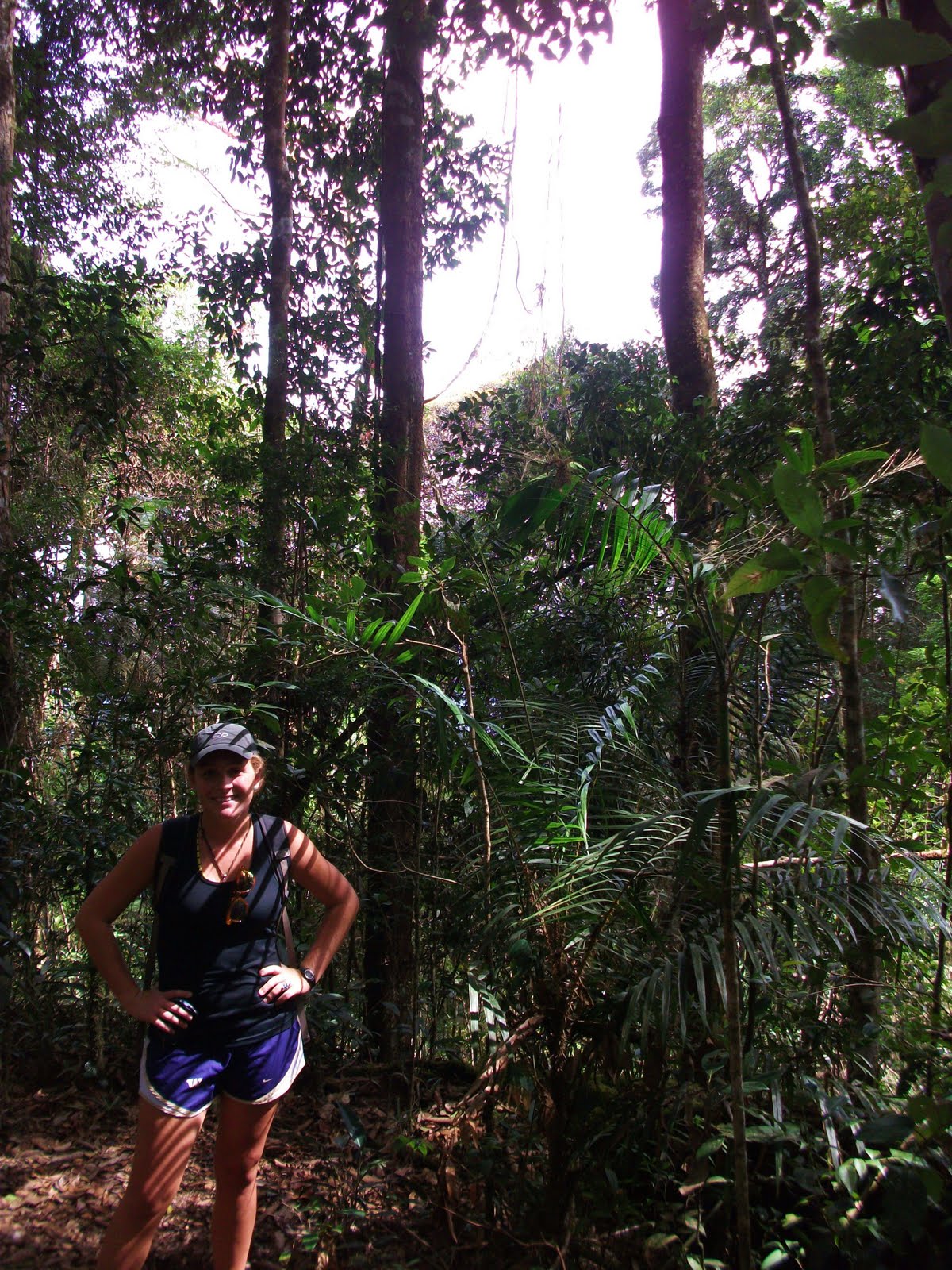
We gave ourselves a couple days to just explore the city's landmarks, parks, and markets. Though this was fun, there isn't all that much to see, so we decided it was time to head to the mountain. Though Mount Kinabalu is climbable for almost anyone in decent shape, we unfortunately are not in decent shape after 3+ months of traveling...just kidding...sort of. Actually, we really wanted to climb to the top of the mountain, which is relatively easy because it receives no snowfall, and is a very gradual ascent. However, this is a very popular tourist destination, and a lot of people will take a vacation solely to climb Mt. Kinabalu. So, unfortunately, all the available beds at mid-camp were booked long before we even arrived in SE Asia. We told ourselves that hiking through the foothills around the mountain would be just as cool, as well as a lot cheaper... and we were right!  Not only did the hikes take us on absolutely gorgeous trails through the jungle, we had the trails to ourselves! It seems that everyone is so concerned about the top of the mountain that there are very few people hiking the trails just below. Over two days, we hiked a very challenging 11 km up and around the mountain. We even hiked from park headquarters all the way up to the mountain base camp on our longest hike! Funny enough, the forest reminded us a lot of ours back home... I guess a rainforest is a rainforest no matter if it's in Borneo or the state of Washington. Overall the trails and wildlife were beautiful and we were glad we made the trek out to Kinabalu National Park.


Side note: When we were waiting for our bus to Mt. Kinabalu, we were invited by a group of firefighters to join a competition they were having. Basically Preston was in a race to put on full firefighter gear and run 50 yards (remember that it's sweltering hot outside). They were so excited to have a foreigner participating, they awarded him a plaque of some kind. We are not sure what it signified, but we're just going to pretend that it was a key to they city, haha.


A view from lunch shows how fast an approaching monsoon can drastically change the weather


Step one: race to put on the outfit


Step two: sprint across the soccer field


The view from the base of Mount Kinabalu


A cabbage-like fungus


Liwagu Trail: A 5.6-kilometer beast of a hike


The mountain was chilly enough to warrant pants and long-sleeves while hiking, a SE Asia first!


Our second big outing from KK was a trip to Mamutik Island. There are several islands just off of the city's coast, which makes for easy day trips. Though we are somewhat island-spoiled from our last month in Thailand and mainland Malaysia (as in used to uncrowded white sand beaches with bathtub-clear water), we still appreciated the proximity of the island and the respite from the city, if only for a few hours. That said, we really wouldn't recommend these islands to anyone if you can avoid it--go to the Perhentians instead!

We spent our last night in KK with some great friends we met on our river safari, Jan and Stephanie from Germany, who we happened to run into again in KK. They showed us to the fish market where you point out what fresh-caught fish you want grilled up for you (we chose a Snapper and a Kingfish), they smother it in spicy sauce, serve it with rice, and you indulge. It's the best fish we've had so far! We also indulged in another very cultural experience that night... watching Toy Story 3 in English 3D! Though this wasn't the most authentically Malaysian activity, it was nice to sit in an air-conditioned theater and get a dose of American culture for a change.


Delicious!